Free Frontline Wellness ROI Calculator

Why Most Workplace Wellness Programs Fail Frontline Teams | Version Best
Version Best
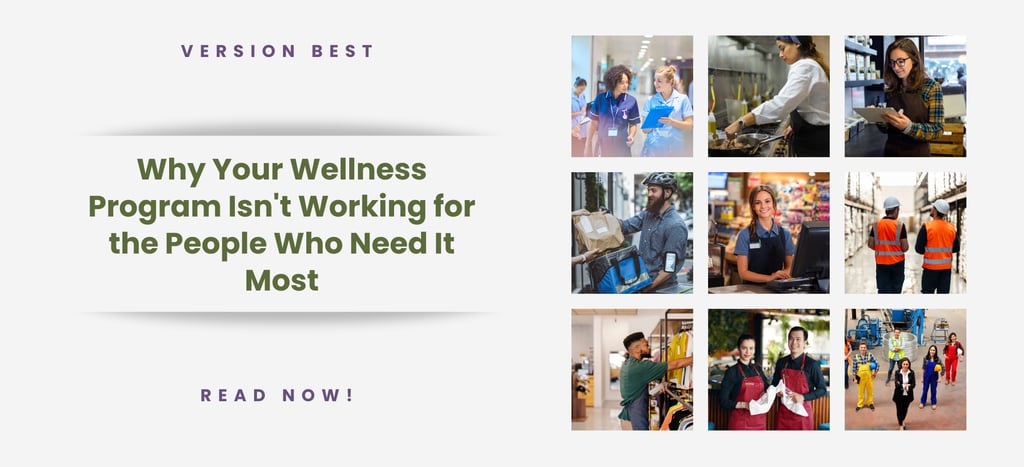
Walk into any retail store, warehouse, or hotel in the UAE and ask a frontline employee about their company's wellness program. You'll get one of three responses: confusion, a polite smile, or a list of benefits they don't have time to use.
It's not because these employees don't care about wellbeing. It's because most wellbeing programs weren't designed for how they actually work.
This gap—between intention and impact—is one of the most overlooked issues in organizational development today. And in a region like the Middle East, where frontline and blue-collar teams power retail, hospitality, logistics, and services, the cost of this oversight is compounding quietly: through fatigue, attrition, errors, and disengagement that nobody connects back to design failure.
The problem: borrowed models, mismatched contexts
Most corporate wellness frameworks assume certain conditions: desk-based work, predictable schedules, time for reflection, access to digital tools, and autonomy over how work gets done.
Frontline roles operate under entirely different constraints:
Shift-based schedules that rotate weekly
Physically demanding work with limited recovery time
High customer interaction requiring constant emotional regulation
Minimal control over pace, breaks, or environment
Supervision structures that prioritize compliance over development
When you apply a model designed for knowledge workers to operational environments, it doesn't just fail—it often backfires. Meditation apps for people working 10-hour standing shifts. Engagement surveys with no feedback loop. Motivational talks in contexts where structural fatigue goes unaddressed.
The result? Performative wellbeing—initiatives that look good on paper but have little impact on energy, behaviour, or performance.
What actually matters: energy, recovery, regulation
If we're serious about workforce wellbeing, we need to start with three operational realities:
1. Energy is finite, and most frontline roles deplete it faster than it can be restored
Wellbeing interventions that ignore physical load, sleep disruption, and cognitive fatigue aren't wellbeing interventions—they're awareness campaigns. Awareness doesn't reduce exhaustion.
What works: Micro-recovery practices built into workflow. Scheduled rotation that accounts for physical demand. Managers trained to recognize early fatigue signals, not just performance drops.
2. Recovery isn't optional—it's where capacity rebuilds
In high-demand environments, recovery is treated as a luxury or personal responsibility. But operationally, recovery is risk management. When people don't recover, errors increase, injuries rise, and turnover accelerates.
What works: Designing recovery into systems—not as time off, but as intentional pauses, reduced cognitive load between tasks, and protection from back-to-back high-intensity demands.
3. Emotional regulation is work—and it's rarely recognized as such
Frontline employees manage customer emotions, navigate cultural complexity, absorb complaints, and maintain composure under pressure. This is invisible labor, and it's exhausting.
What works: Naming emotional labor as real work. Training that builds regulation capacity, not just service standards. Supervision that creates psychological safety, not just accountability.
The Middle East context: complexity at scale
The Middle East adds another layer of complexity. Workforces here are multicultural, multilingual, and often far from traditional support systems. Many frontline employees are managing not just work stress, but displacement, financial pressure, and cultural navigation.
Leadership norms in the region are also shifting—moving away from purely hierarchical control toward more adaptive, emotionally intelligent models. But many managers are caught in the middle: expected to deliver performance while supporting wellbeing, without the training or infrastructure to do either well.
This creates a gap that generic wellness programs can't bridge. What's needed is context-aware design—interventions that account for cultural diversity, power dynamics, and the lived reality of shift-based, high-movement work.
What good looks like: preventive, integrated, dignified
Effective frontline wellbeing doesn't require massive budgets or complex platforms. It requires design thinking and operational discipline.
Here's what shifts the needle:
Preventive over reactive
Instead of wellness programs that respond to burnout, build micro-habits that prevent it. Short pre-shift grounding practices. Mid-shift movement resets. Post-shift decompression cues.
Behavioural over aspirational
Stop selling transformation. Focus on small, sustainable actions that integrate into existing routines. Hydration reminders. Posture checks. Breathing cues between customer interactions.
Dignified over performative
Respect people's time and intelligence. Don't mandate yoga for people who can barely sit down during a shift. Don't ask for vulnerability in environments without psychological safety. Design for dignity, not optics.
Manager-enabled, not employee-dependent
Frontline wellbeing fails when it's positioned as individual responsibility. Managers set the tone—through how they regulate themselves, how they buffer pressure, and how they model recovery.
The business case is already there
Organizations often ask: "What's the ROI of frontline wellbeing?"
The better question is: "What's the cost of ignoring it?"
Fatigue-related errors. Injury rates. Turnover and replacement costs. Absenteeism. Declining customer experience. These aren't soft metrics—they're operational losses that compound over time.
Preventive wellbeing isn't a nice-to-have. It's infrastructure. And like any infrastructure, it either gets designed intentionally—or it breaks under load.
Moving forward
If you're leading workforce development, HR, or operations in the Middle East, here's where to start:
1. Audit your current wellbeing initiatives through a frontline lens
Ask: Does this work for someone on their feet 8 hours a day? Does this fit into a rotating shift schedule? Does this account for cultural and linguistic diversity?
2. Stop measuring engagement. Start measuring capacity
Are people recovering? Are energy levels stable? Are managers creating conditions for sustainable performance?
3. Design with constraints, not around them
Time is scarce. Energy is finite. Trust is earned slowly. Work within these realities, not against them.
The future of work in this region won't be defined by who talks about wellbeing the most. It'll be defined by who builds it into how work actually gets done.
Need help designing wellbeing systems that actually work?
At Version Best, we specialize in preventive wellbeing interventions for frontline and blue-collar teams across the UAE and GCC region—designed for operational reality, not corporate aspiration.
Get in touch to explore how we can support your workforce.
Remote by design. Serving the UAE and India.
Let's talk: hello@versionbest.com
+971 50 450 2035 | +91 88845 95049
© 2025 Version Best. All rights reserved.