Free Frontline Wellness ROI Calculator

The Invisibility Problem
Workplace wellbeing forgot 70% of the workforce. Here's why—and what needs to change.
Version Best
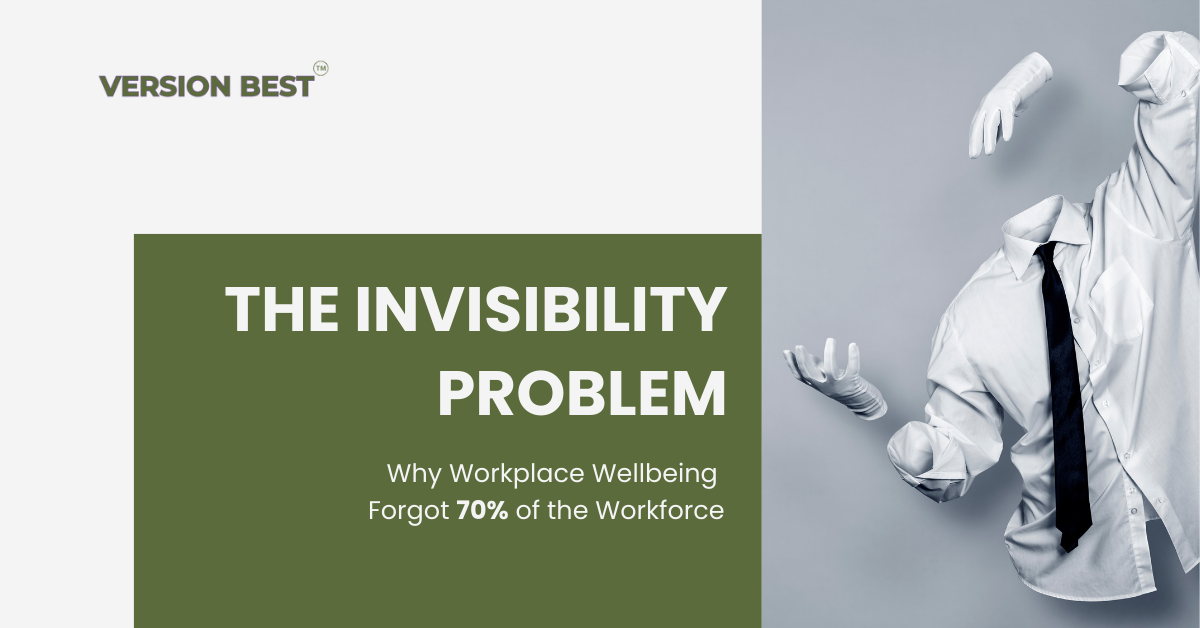
Walk through any discussion of workplace wellbeing, organizational development, or employee engagement and you'll notice something: the entire conversation assumes everyone works at a desk.
Psychological safety workshops scheduled during business hours. Wellness apps requiring smartphone access and Wi-Fi. Employee resource groups that meet over lunch in conference rooms. Coaching programs delivered via Zoom. Even the research underpinning these interventions samples knowledge workers almost exclusively.
Meanwhile, 70-80% of the global workforce is deskless—working in warehouses, on construction sites, in retail stores, hospitals, hotels, and restaurants. In the UAE and GCC, this percentage is even higher. The people powering hospitality, logistics, facilities, construction, and retail rarely appear in workplace wellbeing discourse. When they do, it's as afterthoughts—"frontline workers" mentioned in a paragraph before the conversation returns to corporate employees.
This isn't just an oversight. It's a structural blindness that undermines our credibility as a field.
The desk-centric bias runs deep
Most workplace wellbeing frameworks implicitly assume conditions that don't exist for operational workers:
Digital access – Employee Assistance Programs (EAPs), mental health apps, and online resources assume computer access during work hours. For someone stocking shelves, cleaning hotel rooms, or working a construction site, this infrastructure doesn't exist.
Schedule flexibility – Wellness workshops, coaching sessions, and training programs assume people can shift their calendars. Shift workers can't. A retail employee scheduled to close the store can't attend a 2pm resilience workshop.
Private space – Psychological safety conversations, one-on-one check-ins, and confidential support assume access to private spaces. Operational environments offer break rooms shared by dozens, changing rooms, or nowhere at all.
Manager bandwidth – Most interventions position managers as delivery mechanisms for wellbeing initiatives. But frontline supervisors typically manage 15-30 people with minimal training, working the same demanding schedules as their teams.
Engagement through email – Communications about benefits, resources, and support channels assume regular email access. Many operational workers don't have work email addresses at all.
The result? Research from SHRM and Fidelity found that deskless workers report the lowest feelings of inclusion across all employee types. They experience 1.6x higher turnover than office-based employees. And in manufacturing settings, most employees don't even know wellness programs exist—or assume they're not eligible.
What actually matters for operational wellbeing differs fundamentally
When we actually study frontline and blue-collar workers, different patterns emerge:
Schedule predictability matters more than meditation apps. Irregular shifts, last-minute changes, and unpredictable hours create chronic stress and disrupt sleep, childcare, and recovery. Stable scheduling is a psychological intervention, not just an operational consideration.
Physical environment is psychological environment. Temperature control, break room quality, safety equipment, and workspace ergonomics directly impact mental health. You can't meditate your way out of working in 45-degree heat.
Peer relationships outperform formal programs. Frontline workers consistently report that coworker support matters more than official wellness initiatives. Yet we rarely focus on strengthening horizontal relationships in operational settings.
The manager-supervisor relationship is everything. For workers without HR access, email, or formal development paths, their direct supervisor is the entire "people system." When that relationship is functional, wellbeing improves. When it's not, nothing else compensates.
Recognition and dignity trump perks. Research repeatedly shows that feeling valued, respected, and treated fairly matters more than free snacks or gym memberships. Simple acknowledgment of invisible labor—cleaning, restocking, setup work—has measurable psychological impact.
The GCC adds layers of complexity most frameworks ignore
In the UAE and broader GCC, operational workforces face additional challenges that standard wellbeing models don't address:
Extreme multiculturalism – A single hotel or construction site might employ workers from 30+ nationalities speaking 15+ languages. Interventions designed for culturally homogeneous workplaces fail here.
Visa dependency and power asymmetry – Employment-based visas create psychological dynamics rarely acknowledged in Western organizational psychology literature. Fear of job loss has different weight when it means deportation.
Physical demands in extreme conditions – Construction, landscaping, and outdoor logistics work in GCC summer heat creates physiological stress that compounds psychological load.
Cultural stigma around help-seeking – Mental health support designed for Western contexts assumes employees will voluntarily access resources. In many cultures represented in GCC workforces, this assumption doesn't hold.
Short-term contracts and transience – Two-year employment cycles create different psychological contracts than permanent roles. Wellbeing frameworks assuming long-term organizational attachment miss this reality.
What we need to do differently
If workplace wellbeing wants credibility with the majority of workers, we need fundamental reorientation:
Design for constraints, not around them. Stop assuming people have time, space, digital access, or flexibility. Build interventions that work within operational realities.
Help organizations train frontline managers as psychological first responders. Invest in supervisor capability rather than expecting individual workers to navigate complex wellness systems alone.
Address work design before offering coping tools. Redesign workflows to prevent exhaustion rather than teaching people to cope with unsustainable demands.
Make visibility part of the intervention. Recognition, acknowledgment, and inclusion in organizational communications have measurable wellbeing impact.
Study operational workers, not just knowledge workers. The evidence base remains overwhelmingly WEIRD (Western, Educated, Industrialized, Rich, Democratic) and desk centric. We need research that represents actual workforce demographics.
The workplace wellbeing community talks constantly about evidence-based practice.
But if 70% of workers are invisible in our evidence base, how evidence-based can we claim to be?
Remote by design. Serving the UAE and India.
Let's talk: hello@versionbest.com
+971 50 450 2035 | +91 88845 95049
© 2025 Version Best. All rights reserved.